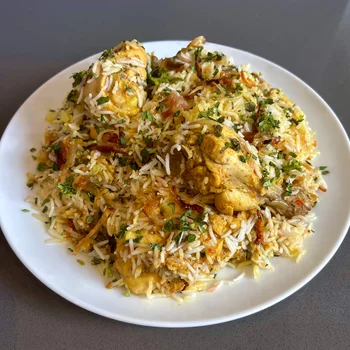
Hyderabadi chicken dum biryani

A rice and chicken dish from Hyderabad made by layering yoghurt-marinated chicken with basmati rice and cooking it sealed on dum. It uses a ground spice mix for the chicken, whole spices in the rice, and is finished with fried onions, mint and coriander, ghee and saffron milk.
Serve with a side of raita (plain yoghurt, onion raita, cucumber raita or mint raita), sliced onion and lemon wedges.
Ingredients
Chicken marinade
- 800 grams Chicken thighs and drumsticks, bone-in and skinless
- 120 grams Plain yoghurt
- 3 cloves Garlic
- 3 centimetres Ginger
- 2 Green chillies
- 0.5 teaspoon Turmeric powder
- 2 teaspoons Chilli powder
- 1 teaspoon Coriander seeds
- 1 Star anise
- 1 teaspoon Whole cloves
- 1 teaspoon Fennel seeds
- 1 teaspoon Cumin seeds
- 1 teaspoon Whole black peppercorns
- 1 teaspoon Salt
Par-boiling the rice
- 2 cups Basmati rice
- 1 litre Water
- 3 Green cardamon pods
- 1 Bay leaf
- 2 Whole cloves
- 1 Cinnamon stick
- 1 teaspoon Salt
Chicken masala
- 2 medium Brown onions
- 3 tablespoons Ghee
Assembly and cooking
- 0.5 teaspoon Saffron strands
- 80 millilitres Whole milk
- 1 handful Fresh mint
- 1.5 handfuls Fresh coriander
- 2 tablespoons Ghee
Instructions
Chicken marinade
- In a dry pan, toast the coriander seeds, star anise, whole cloves, fennel seeds, cumin seeds and black peppercorns for 1-2 minutes until fragrant.
- Cool and grind to a fine powder, then set aside.
- Finely mince the garlic and ginger into a paste-like texture. Slice the chilli lengthwise.
- In a large bowl, combine everything and ensure the chicken is fully covered by the marinade.
- Cover and allow to marinate for at least 2 hours in the fridge (overnight is best).
Par-boiling the rice
- Soak the rice in water for 30 minutes (not the water listed in ingredients) then drain.
- Boil the water (detailed in ingredients). Once boiled, add the soaked rice and aromatics.
- Boil the rice uncovered on high heat for about 5 to 6 minutes (until 60–70% done).
- Drain and set aside. Remove the whole aromatics as well.
Chicken masala
- Heat the ghee in a large heavy-bottomed pot on medium heat.
- Thinly slice the onions and add to the ghee. Allow to fry until a deep golden brown (about 10-15 minutes).
- Remove half the onions and set aside for layering later.
- In the same pot with remaining onions, add the marinated chicken.
- Cook for 8–10 minutes until the chicken is lightly browned and the masala thickens and coats the chicken, adding a splash of water if needed to prevent sticking.
- Remove half the chicken and set aside for layering later.
Assembly and cooking
- Warm the milk and gently stir in the saffron strands. Set aside for 5 minutes.
- Add half the par-boiled rice on top of half the chicken in the pot.
- Chop the fresh mint and coriander and evenly spread half over the rice.
- Evenly distribute half the remaining fried onions and half the ghee (arrange the ghee in small pieces).
- Add remaining chicken then another layer of rice.
- Top with the rest of the coriander, mint, onions and ghee.
- Drizzle saffron milk all over.
- Cover the pot tightly with a lid (and foil if needed) then cook on low heat for 25-30 minutes.
- Turn the heat off and allow to steam with the lid on for another 10 minutes before serving.
Helpful notes
Cooking tips
- Grind the spices finely. Any coarse particles in the marinade will taste harsh once steamed on dum.
- Onion colour sets the flavour base. Stop at deep golden, not dark brown; burnt onions will carry bitterness through the entire dish.
- The yoghurt marinade should cling to the chicken thickly.
- Chicken temperature before cooking. Take the marinated chicken out of the fridge 20–30 minutes before cooking so it browns rather than steams.
- Use a wide, heavy-bottomed pot for frying onions and dum cooking. Thin pans scorch the base before steam builds and won't retain the heat needed to cook the chicken.
- Remove whole spices from the rice. Leaving them in concentrates bitterness whilst cooked in the pot.
- Seal the pot tightly (use foil is needed to help create a seal). Escaping steam is the most common cause of dry biryani. Do not open until the end of cooking time.
- Use visual cues during dum. A faint aroma escaping after 10–15 minutes and gentle condensation under the lid indicate correct heat.
- Rest before opening. The final 10-minute steam allows moisture to redistribute and prevents wet patches.
- Salt in layers, not all at once. The marinade, rice water and final assembly all contribute. Each should taste properly seasoned on its own.
Alternative ingredients
- Neutral oil can replace the ghee when cooking onions but not when layering, but flavour will be lighter.
- Pre-ground spices can be used in place of toasting and grinding whole spices, but use 1.5 times the amount listed.
Storage instructions
Cool the biryani completely before storing. Biryani is best stored fully assembled, not separated.
Refrigeration: Refrigerate in an airtight container for up to 2 days.
Freezer: Freezing is possible but not ideal; rice texture softens on thawing. If freezing, consume within 1 month.
Re-heating instructions
If frozen, allow to defrost in the fridge overnight before reheating.
Oven: Re-heat in a covered dish in a pr-heated oven at 180°C for 20-25 minutes until piping hot throughout.
Stove: Re-heat gently in a covered pan on low heat, loosening carefully from the base. Cook until hot throughout.
Microwave: Cover well and re-heat individual portions in short bursts, stirring gently between, to avoid drying.

Nutrition and dietary facts
Per serving:Calories: 780kcal (35%), Protein: 38g (63%), Fat: 32.8g (41%), Saturated fat: 13g (87%), Carbohydrates: 75.6g (27%), Sugars: 6g (24%), Fibre: 4g (13%)
NOTE: The nutritional information provided for this recipe is an estimate based on ingredients and cooking instructions as described - it is intended for informational purposes only.
Page contents
Featured in meal plans...
No linked meal plans...
View all meal plans