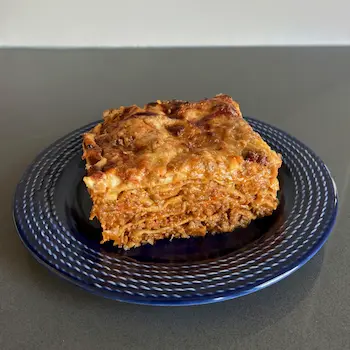
Lasagna alla Bolognese

An Italian baked pasta made by layering fresh egg pasta with a slow-cooked beef and pork ragù, béchamel sauce, and grated Parmesan and Pecorino Romano.
Traditionally served by itself but can be accompanied with a simple dressed green salad and bread.
Join the newsletter
Ingredients
Ragù
- 500 grams Minced beef, 15–20% fat
- 250 grams Minced pork, 15–20% fat
- 50 grams Unsalted butter
- 1 medium Brown onion, finely diced
- 1 large Carrot, finely diced
- 1 large Celery stalk, finely diced
- 250 millilitres Passata
- 150 millilitres Dry white wine
- 200 millilitres Whole milk
- 2 Bay leaves
- 0.25 teaspoon Ground nutmeg
- Salt, to taste
- Ground black pepper, to taste
Pasta
- 250 grams 00 flour
- 2 large Eggs
- 1 large Egg yolk
Béchamel sauce
- 50 grams Unsalted butter
- 50 grams Plain flour
- 500 millilitres Whole milk
- 0.5 teaspoon Ground nutmeg
- Salt, to taste
Assembly
- 150 grams Parmigiano Reggiano, finely grated
- 20 grams Pecorino Romano, finely grated (optional)
Instructions
Ragù
- Melt the butter in a large pot over medium-low heat and add the diced vegetables. Cook gently for 10–15 minutes until soft (no browning).
- Add the minced beef and pork, increase heat to medium, breaking the meat up finely and cook until all the moisture evaporates and the meat is lightly browned.
- Add the white wine and cook until almost completely evaporated.
- Stir in the passata with about half the milk, nutmeg and bay leaves.
- Lower the heat and simmer gently for 1-3 hours (cover partially if cooking for longer). Add the remaining milk in stages, allowing it to reduce fully between additions.
- The ragù should be thick. Remove the bay leaves and allow to cool slightly.
Pasta
- On a clean surface, form a mound with the flour and make a well in the centre.
- Add the eggs and egg yolk into the well.
- Gradually incorporate the flour into the eggs using a fork, then knead until smooth and elastic (8–10 minutes).
- Wrap in cling film and rest for 30 minutes at room temperature (if resting longer, refrigerate, then bring back to room temperature before rolling).
Béchamel sauce
- Melt the butter in a saucepan over low heat.
- Add the flour and whisk continuously to form a smooth roux.
- Remove from the heat and gradually whisk in the milk to prevent lumps.
- Return to medium-low heat and simmer until thickened and smooth.
- Remove from the heat and add the nutmeg and salt.
Assembly
- Preheat the oven to 180°C (fan).
- Roll out the pasta into 5 thin sheets about 1–2 mm thick. This recipe uses a 12x8-inch dish. Cut pasta to fit this size.
- Spread a thin layer of ragù and béchamel in the base of the dish.
- Add a pasta sheet then another thin layer of ragù, béchamel and grated cheese.
- Repeat with the remaining ingredients and finish with the béchamel, ragù and grated cheese on top.
- Cover loosely with foil and bake for 20 minutes.
- Remove foil and bake for another 15–20 minutes until golden.
- Rest for 10–15 minutes before serving.
Video tutorial
Helpful notes
Cooking tips
- Finely dice vegetables to around 3 mm; this helps them soften properly and integrate into the sauce without leaving excess moisture or texture.
- Let the meat cook until moisture has fully evaporated before adding wine; if it’s still wet, it will boil instead of reduce and dilute flavour.
- Reduce the wine until the pan is nearly dry and the smell is no longer sharp or alcoholic. Under-reduced wine will leave a harsh note in the finished sauce.
- Remove excess fat if it starts to pool, otherwise the final ragù can be greasy and split.
- Add the milk in stages and allow it to reduce each time; this stabilises the sauce and softens acidity rather than just making it creamy.
- The finished ragù should be thick and cohesive, with no visible liquid pooling.
- The béchamel should coat the back of a spoon but still flow. If it thickens too much, adjust with milk off the heat.
- Roll the fresh pasta to ~1 mm; thicker sheets absorb too much moisture and make the lasagna dense rather than layered.
- Keep layers thin and evenly distributed as overly thick layers will trap moisture and prevent the lasagna from setting cleanly, resulting in a loose structure.
- Rest at least 10–15 minutes as internal steam needs to settle or the layers will collapse and leak when cut.
Alternative ingredients
- White wine gives a lighter, cleaner flavour whereas red wine adds depth. Both work well and are up to personal preference.
- If omitting the wine, replace with an equal amount of stock.
- Chopped tomatoes can be used instead of passata; however, it will introduce more water and require longer to reduce.
- Dried pasta sheets can be used instead of making fresh pasta; however, I find the texture can be a bit lacking but are fine if needed. Either par-boil the dried pasta or allow to cook while baking - just try to avoid overcooking the pasta.
Storage instructions
Cool completely before refrigerating; trapping heat creates condensation that can affect the texture.
Refrigeration: Baked lasagna can store covered for 3–4 days. Assembled (unbaked) lasagna can be refrigerated for up to 24 hours.
Freezer: Freeze either baked or unbaked in individual portions to improve reheating consistency.
Re-heating instructions
From frozen, thawing first gives better results but it can be reheated from frozen in the oven.
Oven: Preheat the oven to 180°C (or 160°C if frozen) and bake the lasagna covered until heated through - about 20-25 minutes (or 35 minutes if frozen). Then uncover and bake until the cheese is golden.
Microwave: Best for reheating single portions but softens layers.

Nutrition and dietary facts
Per serving:Calories: 761kcal (34%), Protein: 41g (68%), Fat: 42.9g (54%), Saturated fat: 20.3g (135%), Carbohydrates: 47g (17%), Sugars: 9g (36%), Fibre: 3g (10%)
NOTE: The nutritional information provided for this recipe is an estimate based on ingredients and cooking instructions as described - it is intended for informational purposes only.
Page contents
Featured in meal plans...
No linked meal plans...
View all meal plans